
Plugging Into the Electric Flute World with Melissa Keeling
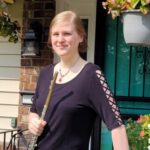

I was recently very fortunate to go to Robert Dick’s “Contemporary Flute Week” retreat where I met the co-host of many of the workshops, Melissa Keeling, electric flutist. Melissa is a fabulous flutist with a unique sound, and I am thrilled to be talking with her here about her musical journey!
Hi Melissa! I am so excited to be talking with you today! I can’t wait to hear all about your work as an electric flutist, but first of all, can you please give us a little bit of background on yourself and your music?
Thank you so much for having me! It was great to get to work with you at the Contemporary Flute Week. I wear a lot of different hats professionally, and love it all. I’m a freelance flutist, composer, improvisor, and band leader. I teach at Western Kentucky University and am the music librarian with Orchestra Kentucky. I’m really grateful to be a musician, and love how music has taken me all over the country and led me to meet so many fantastic people.
You are most well-known today as an electric flutist. For those who might be unfamiliar with this term, what exactly is electric flute playing and how did you come about playing this kind of music?
The “electric flute” is playing flute with a microphone and effects pedals. It’s not truly electric in the sense that the electric guitar is. I kind of accidentally stumbled into the effects world. During my last month of undergrad, I was feeling pretty burned out on music and wasn’t really sure what I was going to do after graduation.
I went to my boyfriend’s apartment (we’re married now, it worked out), and he was playing guitar with effects pedals and just having a great time. I hadn’t felt like the flute was FUN in a long time, and it seemed like the effects were really fun. I got a microphone and connected the pedals to an amp. I’ll never forget the first time I heard my flute with the delay turned on. It was an immediate feeling of “THIS IS IT.” As cliché as this sounds, it felt like golden sparkles came down from the sky, and I knew this was my voice.
Before this moment, I hadn’t really composed, improvised, arranged, or used any effects pedals before. At the time, there was very little music written for flute and pedals, so I immediately realized that there was a lot I needed to learn in order to do this. It’s been extremely rewarding — and FUN!! — exploring the musical opportunities that effects can offer. Allowing my curiosity to lead the way, rather than external pressure of “this is what you should do,” has been a healthy way for me to operate as a musician.
Any advice for flutists looking to start playing with effects themselves?
Go for it! Don’t stress out about the exact gear to get, just get a functioning setup and see where it takes you and how you like it. I recommend a Shure SM58 mic and the BOSS VE-20 (or VE-22) Vocal Effects processor, which you can use with headphones. It’s a simple, reliable, and affordable setup.
Playing with effects opens up a new way of playing and thinking about your approach to the flute. Some of the mental blocks that come with playing the flute just melt away when I play with effects. I find myself thinking more creatively about the MUSIC, and not just about “playing the flute.” This is a much more rewarding (and sustainable) mind-set, at least for me, and I hope for you, too. It’s pretty addictive, so be warned!!
(For more information about playing flute with effects pedals, check out Melissa’s book “The Electric Flute“)
In addition to playing with effects pedals, you also play with a glissando headjoint. What got you into playing with one and how do you use it in your music?
The glissando headjoint completely revolutionizes the sound of the flute. While the “glissando” aspect is neat, the real power to me lies in the ability to play in a portamento style — the small bends that make melodies more voice-like. Singers bend notes constantly. Even non-professional singers (like myself) intuitively bend notes when singing. The same idea applies to glissando flute playing. It’s baked in to everything I do melodically. While there is music written specifically for it, I use it primarily when improvising. It’s my primary headjoint.
I got my glissando headjoint right at the time I was finishing studying with Robert Dick in 2014, so he is a clear influence. I love rock music, and I have spent lots of time transcribing electric guitar solos. It’s hard to match the expressiveness of the electric guitar in rock/blues styles without bending notes, and the glissando headjoint opens that door. It really is like a whammy bar for the flute!
(Melissa has more information and a book about playing the glissando flute available here)
You have written a lot of compositions and arrangements, and you also like to improvise. What inspires your own pieces and how do you also incorporate improvisation into them and throughout your playing?
That’s a good question. Improvisation is when I feel the most free, both musically and personally. It’s healing for me. It’s less “something I do” and more “who I am.” Most (if not all) of my through-composed pieces (“Tilt,” “Northern Lights”) are really transcriptions of improvisations. Other pieces are designed to be vehicles for improvisation, like my pieces for loop pedal (“Among the Stars”, “Kings of the Sky”).
I didn’t intend to become a composer, per se. I created these pieces for myself to have something to play with the pedals. Over time, others have asked to play them too. I’m always really honored when someone plays my music.
Now we of course have to talk about Wolf, your band. How did Wolf get started and can you tell us about your music?
Wolf is probably one of my favorite projects ever. I’ve always wanted to be in a rock band. The music we play is heavily improvised, borrowing from the spirit of bands like the Grateful Dead. Thinking back through this interview, there’s a trail of breadcrumbs that logically lead here: breaking free from classical music, delving into effects and the glissando headjoint, learning to improvise, and my love of rock music. I tried starting this band for many years before it really coalesced in 2023. Luckily, I’ve been fortunate to have met some fantastic musicians that are willing to play together, and I certainly don’t take it for granted.
Some of my favorite musical memories have been with Wolf. There’s nothing like feeling the energy of the room, the light show going off, standing right in front of a drum kit, and people really digging what you’re doing.
What are your future plans? For both yourself and Wolf!
We’ll see! I just finished writing a duet for electric glissando flutes and backing track that will be recorded later this year. I’m looking forward to playing some festivals this fall with Wolf, too. I plan to keep doing what I’m doing, following my curiosity and joy, and see where it leads next.
Where can we listen to your music, and how can we contact you or follow you on social media?
You can find me streaming on all the platforms — YouTube, Spotify, Bandcamp, etc. You can support me more directly by ordering my books and CDs through my website, www.melissakeeling.com. Feel free to reach out any time on Facebook, Instagram (@_melissakeeling), or email (melissa@melissakeeling.com).
Thank you so much for talking with me here today! I am very grateful to have had the chance to find out more about your amazing work and hopefully continue to spread the love of electric flute playing! Do you have any parting thoughts?
I really appreciate you inviting me to do this, thank you so much! Stay in touch!


