
Nicholas Bannan and His Composition, “Aeolia”, for Flute Choir
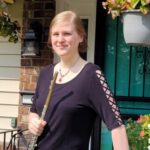

A conversation between Erika Skye Andres, flutist, and Nicholas Bannan, composer, regarding his composition, “Aeolia”, for flute choir.
(Andres) Hi Nicholas, I am excited to be talking with you today about your composition, “Aeolia” for flute choir! Can you please tell us a little bit about yourself and what got you into composing?
(Bannan) I was from the age of eight a chorister at Canterbury Cathedral, and we sang a lot of quite new music by composers such as Britten, Messiaen, Tippett, Harvey and Tavener, and especially by Alan Ridout, who was effectively composer in residence. He started teaching composition at the Choir School, and I began writing music at the age of about 10 and have never really stopped.
I went on to Cambridge University where I performed a lot of contemporary works – choral pieces by Maxwell Davies and Goehr, and instrumental works by Penderecki. I studied with Robin Holloway and Hugh Wood, and developed a style influenced both by composers such as Stockhausen and by the earlier figures whose works we performed with period instruments, such as Monteverdi and the Gabrielis.
Aeolia is a unique work for flute choir with an equally unique name. Can you tell us about the work and why you wrote it?
The title refers to Aeolus, ‘ruler of the winds’, and to the modal nature of the harmonic language. I have always enjoyed writing pieces with cyclic forms: not so much theme and variations, but with patterns of growth and development akin to tidal ebb and flow.
Aeolia is written for nine flutes: 4 concert flutes (2 of which double on piccolo), 2 alto flutes, 2 bass flutes, and a contrabass flute. Can you tell us why you wrote this piece for a flute choir and why you chose this specific combination of flutes? What do you like about writing for flute?
We were all tried out on instruments in our first year at Canterbury. I was already playing the violin, but I was present when a young Trevor Wye showed a group of us how to get a sound out of the flute. I could only manage a breathy chaos, but one of my friends, Paul Edmund Davies, effortlessly blew a well-formed note. Trevor took him on as a pupil, and he went on to be Principal Flute of the London Symphony Orchestra. So, I was surrounded by really good flute players from early on.
When we moved to Perth, Australia, in 2006, I soon met Neil Fisenden and his wife Rae-Helen, who together with friends had this wonderful nine-instrument ensemble. They commissioned Aeolia for the group to take to Las Vegas for a World Flute festival – for which I also wrote an encore arrangement of Waltzing Matilda. In writing Aeolia, I had in mind textures that covered that broad range – introducing the two piccolos to accentuate that in the central section – while at the same time exploring the overlaps available. They told me not to write high for the Contrabass, but when I heard it I simply could not resist throwing in a brief solo, which sounded to me like a baby crying!
These considerations of range and collective performance have always interested me as a singer and choral director, and parallel the work I have done as a researcher into the evolutionary origins of music and the human voice. They appear in other pieces of mine such as Round-Dance for eleven solo strings, Ensemble for six guitars, and a recent Quartet for Four Tenor Saxophones.
Since Aeolia is new, it has not yet been recorded, but here is an electronic sound recording for your enjoyment.
What future projects are in the works? Are there any other works for flute we should be expecting?
I have just completed an opera on which I have been working for some 30 years. I would love to compose further for the flute – perhaps a Quartet – if anyone would like to commission me!
Where can we listen to your other music? And do you specifically have any other flute works we should check out?
Since retiring in 2020, I have been putting together a website: https://www.nicholasbannan.com/
I am working with my web designer on placing recordings and links there so that people can hear more of my music.
I have included flute in several chamber works, but not written any solo pieces. Maybe I should…
How can interested flute choirs get hold of the score to Aeolia and where can we contact you?
Contact through the website and the Zoho address will find me. I will be very happy to send sound files, scores and parts to anyone interested.
Thanks so much for talking with me today, it is always wonderful to get to know composers who have a fondness for flute! Any final thoughts?
I really appreciate this opportunity to talk to a flute specialist from another part of the world about my work and interests.
As part of my evolution research, I once met the people who found and studied the oldest known flute from 30,000 year BCE, led by the archaeologist, Nicolas Conard. From my perspective, it is the most significant pitched instrument in human history after the voice itself!


